Ep 88 - The Long Walk Back to Institutions
Jun 22
6 min read
Nobody has to announce that they are bringing institutions back. They do not have to hold a press conference, unveil a banner, or say the quiet part into a microphone. The long walk back to institutions can begin much more quietly than that. It can begin with a legal opinion. A budget line. An agency transfer. A waiting list. A phrase like “limited resources,” delivered in the same calm voice people use when telling families there is no help available, but thank you for calling.
That is what makes this moment so dangerous. The Trump administration’s Justice Department has now issued a legal opinion arguing that the federal integration mandate was not actually required by the ADA or Section 504 of the Rehabilitation Act. That mandate is not some obscure decorative flourish in disability law. It is part of the legal floor that helps protect disabled people from being unnecessarily segregated away from their communities. It is one of the rules that says disabled people should receive services in the most integrated setting appropriate to their needs. In plain English: if someone can live in the community with support, the state should not shove them into an institution because the institution is easier, cheaper, or already has a bed.
To be clear, this opinion does not repeal the rule by itself. It does not overturn Olmstead. It does not mean every disabled person receiving community services wakes up tomorrow and loses support. That matters, because panic is not precision, and precision matters here. But it does give the administration a roadmap. It gives them a formal legal argument for weakening enforcement, backing away from federal responsibility, and telling states they may not have the same obligation to support community living that the federal government has long said they had.
And that does not happen in a healthy system. It happens in a system already cracking. Medicaid home- and community-based services are already hard to get in much of the country. In 2025, KFF reported that 41 states had waiting lists or interest lists for these services, with more than 600,000 people waiting. The average wait was 32 months overall. For intellectual and developmental disability services, 37 months. For autism waivers, 63 months. That is more than five years. That is not a delay. That is a childhood. That is a caregiver aging. That is a family running out of air.
This is why “limited resources” is such a loaded phrase. In a government document, it sounds sterile. In real life, it means a parent still lifting an adult child because staffing never came. It means a group home closing because workers are underpaid and exhausted. It means someone qualifying for support but never actually receiving it. It means a family being told, yes, the service is appropriate, but no, there is no slot. The burden does not disappear. It moves. From the state to the family. From the agency to the caregiver. From public obligation to private collapse.
That is how institutionalization becomes more likely without anyone officially ordering it. You underfund the community system. You let waiting lists grow. You make enforcement harder. You scatter responsibility across agencies. You tell families to appeal, wait, document, resubmit, prove it again, call back next month. Then, when the family finally breaks or the crisis finally arrives, the system offers the only thing still standing. A nursing facility. A psychiatric placement. A large congregate setting. A bed where a life should have been.
The institution does not have to be forced. It only has to be the last option left.
That is the moral sleight of hand here. The state can starve the better options and then pretend the worst option is unavoidable. It can refuse to build the bridge and then blame people for being stranded. It can call community services unrealistic after making sure they are underfunded, understaffed, and impossible to access. This is not care. This is abandonment with a lawyer attached.
The broader context makes it worse. The administration is also moving special education oversight toward Health and Human Services and education civil-rights enforcement toward the Justice Department as part of its effort to break apart the Department of Education’s role. That should alarm families. Special education is not just a service program. It is a civil-rights structure. An IEP is not a medical chart. Disabled students are students first, not diagnoses passing through a classroom on their way to a billing code.
When disability systems are moved away from education and civil rights and toward health bureaucracy, the frame changes. The civil-rights question is: what does this person need in order to participate, learn, live, work, and belong? The medical-management question can become: what is the condition, what is the cost, and where can the case be handled? Those are not the same question. One starts with citizenship. The other starts with containment.
And no, we cannot prove private motive unless someone says it outright. But we can read the pattern. We can see the legal retreat. We can see the agency reshuffling. We can see the waiting lists. We can see the old language of “state flexibility” creeping back into places where federal rights are supposed to matter. We can see a system being made easier for states to ration, delay, deny, and defend. At some point, the question is not whether anyone admits to wanting a return to institutions. The question is whether their policies make that return easier.
History matters here because institutionalization was often sold as kindness. It was sold as care, protection, safety, expertise, and realism. Families were told it was for the best. Many were given no meaningful support and then blamed when they could not manage alone. Disabled people lost homes, schools, neighborhoods, work, privacy, autonomy, friendships, family life, and ordinary dignity under language that sounded professional enough to pass through polite rooms. That is why “most integrated setting” is not bureaucratic filler. It is a wall between disabled people and a past this country should be ashamed of.
Disabled people do not need pity. They need rights. They need services. They need staffing. They need housing. They need education. They need enforcement. They need a government that does not treat their lives like an accounting error. Community living is not some soft little extra for when budgets are comfortable. It is the difference between inclusion and disappearance. Between a person having a life and a person being assigned a placement.
So no, this is not about claiming that every community service vanishes tomorrow. It is about noticing when the floor starts to weaken. It is about understanding that rights on paper do not mean much when the enforcement machinery gets unplugged. It is about recognizing that if community supports are starved long enough, institutions do not have to be announced. They simply wait.
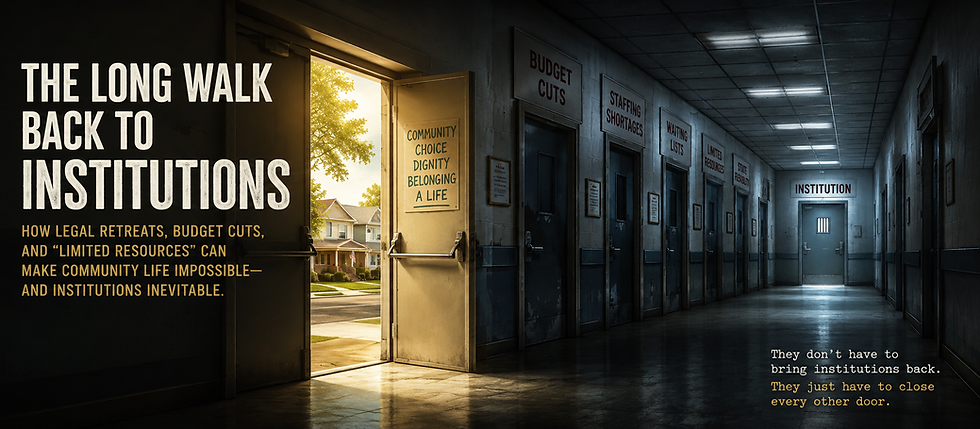
The long walk back to institutions does not begin with a locked door. It begins when every other door is quietly closed.
SOURCES
DOJ Office of Legal Counsel opinion on the ADA, Section 504, and the integration mandate — https://www.justice.gov/olc/media/1446701/dl
HHS Office for Civil Rights overview of Olmstead and community living in the most integrated setting — https://www.hhs.gov/civil-rights/for-individuals/special-topics/community-living-and-olmstead/index.html
HHS explanation of Olmstead requirements for states and community-based services — https://www.hhs.gov/civil-rights/for-individuals/special-topics/community-living-and-olmstead/serving-people-disabilities-most-integrated-setting.html
ADA.gov overview of community integration and the ADA integration mandate — https://www.ada.gov/topics/community-integration/
DOJ statement on enforcement of the ADA integration mandate and Olmstead v. L.C. — https://www.ada.gov/resources/olmstead-mandate-statement/
KFF report on Medicaid home- and community-based services waiting lists from 2016 to 2025 — https://www.kff.org/medicaid/a-look-at-waiting-lists-for-medicaid-home-and-community-based-services-from-2016-to-2025/
KFF overview of Medicaid home care and home- and community-based services in 2025 — https://www.kff.org/medicaid/medicaid-home-care-hcbs-in-2025/
CBS News report on the new DOJ opinion and its possible effect on community-based disability services — https://www.cbsnews.com/news/doj-disability-opinion-community-care/
AP report on Trump administration moving special education oversight to HHS and education civil-rights enforcement to DOJ — https://apnews.com/article/3483478a51ea8001fcc70e8a77d08d9a
AP explainer on shifting special education and civil-rights responsibilities out of the Education Department — https://apnews.com/article/043d48432bfd182cdce3743a397ce633
The Arc analysis warning that the DOJ Olmstead opinion threatens community living rights — https://thearc.org/blog/doj-opinion-on-olmstead-threatens-the-right-of-people-with-disabilities-to-live-in-the-community/
The Arc analysis on moving special education and civil rights out of the Education Department — https://thearc.org/blog/moving-special-education-and-civil-rights-out-of-education-department-risks-a-patchwork-of-rights-for-students-with-disabilities/
Center for Public Representation explanation of Olmstead v. L.C. and the right to community participation — https://www.centerforpublicrep.org/the-right-to-community-participation-olmstead-v-l-c/
Center for Public Representation statement condemning the administration’s attack on community integration rights — https://www.centerforpublicrep.org/news/cpr-condemns-administration-attack-on-the-rights-of-individuals-with-disabilities-to-be-integrated-in-their-communities/
American Association of People with Disabilities statement on the DOJ memo and Olmstead — https://www.aapd.com/aapd-horrified-by-doj-olmstead-memo/



Comments