Ep 87 - Back Porch Files: The People Who Know Too Much
Jun 19
7 min read
Nobody hates experts when the plane is landing. Nobody hears the pilot’s voice over the speaker and thinks, “I hope this guy rejected the tyranny of aviation school.” Nobody wants a dentist who “did his own research,” a bridge designed by a podcast guest, or a surgeon whose main qualification is confidence and a steak knife. We understand expertise perfectly well when the consequences are immediate.
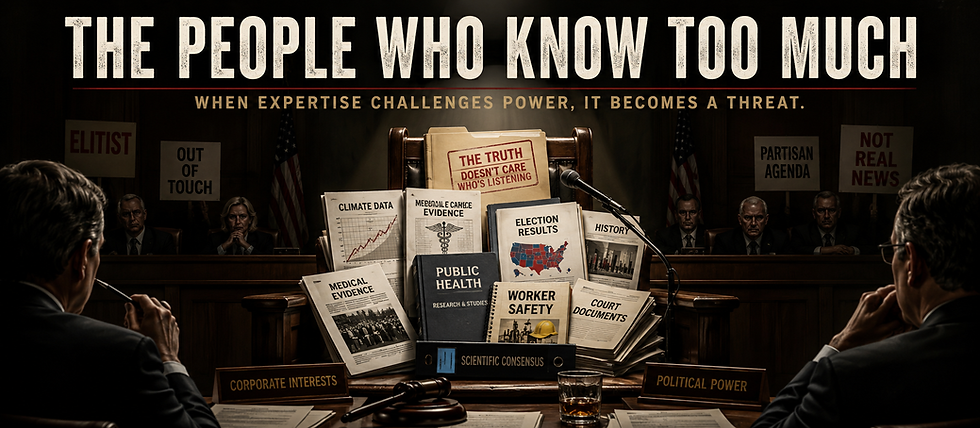
But something changes the moment expertise becomes politically or financially inconvenient. A scientist says the planet is warming, and suddenly science is a hoax. A doctor says vaccines save lives, and suddenly medicine is tyranny. A historian says American history is more complicated than a parade float, and suddenly history is indoctrination. An election official says the votes were counted accurately, and suddenly election workers are part of the deep state.
That is the trick. The powerful do not hate expertise. They use it constantly. Corporations hire experts. Campaigns hire experts. Billionaires hire tax experts so skilled they can make money disappear into a legal fog bank with a polite little invoice attached. They love expertise when it serves them. What they hate is expertise they cannot control.
They hate the expert who says no. No, that claim is false. No, that policy will hurt people. No, that drug price is not inevitable. No, that denial of care is not medical judgment. No, that election was not stolen. No, history does not disappear because it makes someone uncomfortable. No, reality does not bend just because power demands it.
That does not mean experts are always right. They are not. Doctors can miss things. Scientists can revise conclusions. Journalists can make mistakes. Universities can be arrogant. Government agencies can be slow, defensive, political, or too cozy with the industries they are supposed to regulate. Public trust has been damaged, and not always for imaginary reasons.
But the answer to flawed expertise is not propaganda. It is better expertise. More transparency. More accountability. More independence. More public-interest science. More people protected enough to tell the truth without getting crushed for it. The fact that experts can be wrong is not proof that amateurs, influencers, loyalists, conspiracy merchants, or supplement salesmen are automatically right.
This is where the modern right has become especially useful to corporate power. It teaches people to distrust the scientist, the teacher, the journalist, the public health official, the election worker, the regulator, and the historian. Then, while voters are told to rage against “elitists,” corporations get what they wanted: less oversight, weaker rules, lower accountability, and more room to profit.
The voter gets the culture war. The corporation gets the deregulation. That is the bargain hiding in plain sight. The voter is told that climate science is liberal hysteria. The fossil fuel industry gets delay. The voter is told that regulation is tyranny. The polluter gets freedom. The voter is told that doctors and public health experts are corrupt. The insurance company gets another layer of denial.
And the pattern does not stop with corporations. Authoritarian politics needs the same thing. It needs people to trust the leader over the document, the slogan over the data, the party over the evidence, and the performance over the truth. Independent expertise interrupts that arrangement. It puts a speed bump on the road to propaganda.
That is why so many different professions get attacked with the same basic language. The press is the enemy. The courts are rigged. The universities are brainwashing factories. The scientists are bought. The teachers are indoctrinators. The civil servants are the deep state. The historians are anti-American. The fact-checkers are censors. Different targets. Same move.
You do not have to answer the evidence if you can destroy trust in the person presenting it. That is the whole little poisoned apple. If every expert is corrupt, every fact is partisan, and every institution is a conspiracy, then the only thing left is loyalty. Who tells the truth? Your side. Who lies? Everyone else. Congratulations, you have built a political bunker with snacks.
This also explains why education itself has been recoded as contamination. In certain right-wing spaces, a degree no longer means someone studied a subject. It means someone was programmed. Professors do not teach. They indoctrinate. Students do not learn. They are captured. Expertise becomes not the result of study, but proof of infection.
To be clear, this is not about college versus no college. Some of the smartest people in this country never set foot in a university, and some of the dumbest ideas in America come with citations. A degree does not make someone wise, decent, honest, or right. The issue is whether knowing more about a subject now makes someone less trustworthy.
That is the poison. When education is treated as ideological infection, ignorance can be marketed as authenticity. Not knowing becomes proof that you have not been corrupted. Not reading the report becomes proof that you are not captured by the system. Refusing to understand the issue becomes bravery with a bumper sticker.
Then come the replacement experts. The climate scientist is swapped out for the fossil-fuel-funded think tank. The doctor is swapped out for the wellness influencer. The historian is swapped out for the patriotic propaganda shop. The journalist is swapped out for the partisan content mill. The career public servant is swapped out for the loyalist. The researcher is swapped out for the podcast guest who is “just asking questions” for ninety uninterrupted minutes.
This is where RFK Jr. and the MAHA movement fit into the larger picture. Not because every concern they raise is imaginary. Chronic disease is real. Ultra-processed food is real. Big Pharma has earned scrutiny. Insurance companies interfere with care in ways that should make any decent person want to throw a printer through a wall. Corporate capture is not a fantasy.
But the useful question is: how do we build stronger, more independent public systems that can stand up to corporate power? Too often, the MAHA-style answer becomes: the whole system is lying to you, so trust the personalities who built their brands telling you the whole system is lying to you. That is not accountability. That is a swap meet for paranoia.
There is a difference between saying corporate power can corrupt science and saying science itself is corrupt. There is a difference between saying public health agencies have made mistakes and saying public health is tyranny. There is a difference between saying pharmaceutical companies have too much influence and saying medical consensus is a scam. That leap is where legitimate distrust gets fed through the wood chipper and sprayed back out as misinformation.
The answer to corporate capture is not less expertise. It is independent expertise with teeth. Food scientists. Environmental testing. Medical research. Public health systems. Regulators who can enforce rules. Doctors whose judgment is not buried under insurance paperwork. Researchers who can follow evidence without a boardroom breathing down their necks.
A modern society is too complicated for every person to personally verify everything from scratch. You cannot smell every toxin, audit every hospital bill, inspect every bridge, test every medication, model the climate from your back porch, read every corporate filing, and still have time to make dinner. That is not an insult. That is reality.
This is why the war on expertise is so dangerous. It does not make people free. It makes them easier to fool. It leaves regular people angry, exhausted, suspicious, and dependent on whoever can package certainty most aggressively. It replaces accountable expertise with unaccountable confidence.
Skepticism is healthy. Ask questions. Demand evidence. Follow the money. Look for conflicts of interest. Challenge institutions. Experts should not be worshiped, and institutions should not be blindly trusted. But skepticism asks hard questions. Sabotage dismisses the answer before it arrives.
A democracy needs people who know things. Doctors who can tell the truth about disease. Scientists who can tell the truth about the planet. Teachers who can tell the truth about history. Journalists who can tell the truth about corruption. Judges who can tell the truth about the law. Election workers who can tell the truth about votes. Public servants who can tell the truth even when the truth annoys the person in charge.
Those people should be questioned. They should be accountable. They should be corrected when they are wrong. But they should not be destroyed because their knowledge got in the way of a slogan, a profit margin, a political fantasy, or a powerful man’s ego.
When politicians, pundits, influencers, and corporate mouthpieces tell you not to trust experts, listen closely. Ask which experts they want you to distrust. Ask what those experts were warning about. Ask who benefits if the warning is ignored. Ask what replacement authority they are offering instead. Very often, they are not freeing you from elites. They are cutting the alarm wire and calling it independence.
They do not hate expertise because experts know everything. They hate expertise because sometimes experts know enough to say no.
SOURCES
ExxonMobil internal climate projections and the accuracy of the company’s own climate science - https://www.science.org/doi/10.1126/science.abk0063
Harvard Gazette summary of the ExxonMobil climate projection study - https://news.harvard.edu/gazette/story/2023/01/harvard-led-analysis-finds-exxonmobil-internal-research-accurately-predicted-climate-change/
Union of Concerned Scientists overview of industry tactics used to sideline science and mislead the public - https://www.ucs.org/resources/disinformation-playbook
History of the tobacco industry’s “doubt is our product” strategy - https://www.healthandenvironment.org/resources/resource-library/eh-history/tobacco-doubt-is-their-product
American Medical Association survey on prior authorization burdens and insurer reform pledges - https://www.ama-assn.org/practice-management/prior-authorization/ama-prior-authorization-physician-survey
National Association of Insurance Commissioners explanation of prior authorization - https://content.naic.org/article/what-prior-authorization
CMS fact sheet on Medicare drug price negotiation and negotiated prices for 2026 - https://www.cms.gov/newsroom/fact-sheets/medicare-drug-price-negotiation-program-negotiated-prices-initial-price-applicability-year-2026
FDA overview of the drug development and approval process - https://www.fda.gov/patients/learn-about-drug-and-device-approvals/drug-development-process
Pew Research Center report on partisan views of colleges, universities, and public schools - https://www.pewresearch.org/politics/2024/02/01/colleges-and-universities-k-12-public-schools/
Pew Trusts summary on Americans’ deepening mistrust of institutions, including partisan divides over higher education - https://www.pew.org/en/trend/archive/fall-2024/americans-deepening-mistrust-of-institutions
Gallup report on public confidence in higher education - https://news.gallup.com/poll/692519/public-trust-higher-rises-recent-low.aspx
FactCheck.org timeline of RFK Jr.’s mixed messaging on the measles vaccine - https://www.factcheck.org/2026/05/a-timeline-of-rfk-jr-s-mixed-messaging-on-the-measles-vaccine/
CDC measles vaccine recommendations and MMR effectiveness - https://www.cdc.gov/measles/hcp/vaccine-considerations/index.html
KFF tracking poll on health information, vaccine safety, and trust - https://www.kff.org/health-information-trust/kff-tracking-poll-on-health-information-and-trust-vaccine-safety-and-trust/
KFF tracking poll on public trust in doctors, government health agencies, and vaccine information - https://www.kff.org/health-information-trust/public-trust-in-vaccine-information-misrepresented-vaccine-studies-and-hiv-and-prep-stigma/


Comments