Ep 47 - Trump, Biden, and the Autopen: How a Signature Machine Became Political
Mar 15
3 min read
In modern American politics, even the most mundane bureaucratic details can suddenly become the center of national controversy. The latest example? A small mechanical device called an autopen.
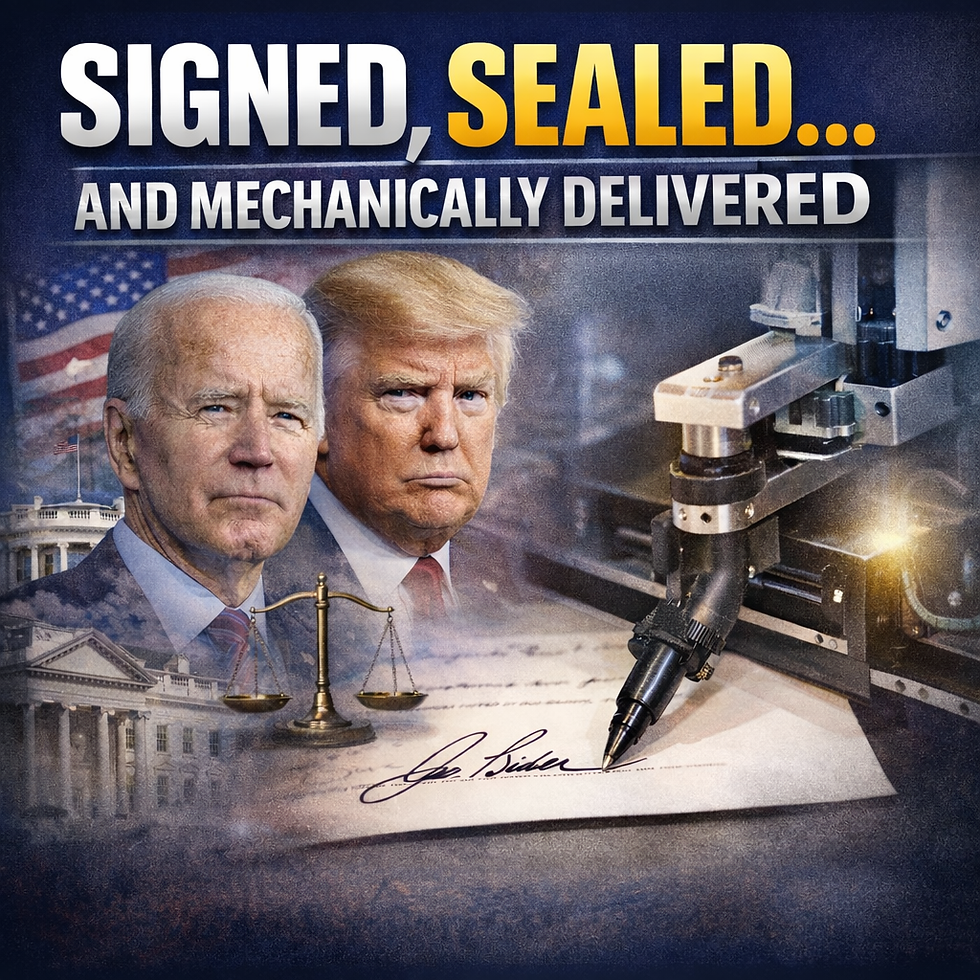
If you’ve never heard of an autopen, you’re not alone. For decades it was one of the most boring tools in the federal government. An autopen is simply a machine that replicates a person’s signature. A real pen is placed into the device, and the machine traces a programmed pattern that duplicates the signature with remarkable precision. This technology has existed for nearly a century and has been used by corporations, celebrities, and government offices to manage large volumes of documents requiring signatures. Eventually, the device made its way into the White House.
The reason is simple: the President of the United States signs an enormous number of documents. Legislation passed by Congress, executive orders, military commissions, proclamations, diplomatic correspondence, and routine administrative paperwork all require the president’s name. Over time, autopens became a quiet administrative tool that allowed the White House to process that paperwork efficiently.
Presidents from both parties have used the device. One of the earliest presidents associated with mechanical signature devices was Harry S. Truman, and later administrations continued the practice without controversy.
The issue first entered the national spotlight during the presidency of Barack Obama. In 2011, Obama was traveling in Europe when Congress passed legislation extending parts of the Patriot Act. Because the bill needed to be signed quickly and the president was overseas, the White House used an autopen to sign the legislation into law.
The moment sparked a brief constitutional debate. The Constitution says the president signs legislation, but does that mean the president must physically hold the pen? The Justice Department reviewed the issue and concluded that the practice was constitutional. What matters is that the president authorizes the signature; the autopen simply carries out that authorization. The controversy faded, and the device returned to its normal role as a quiet bureaucratic tool.
That changed recently when questions were raised about the use of an autopen during the presidency of Joe Biden. Toward the end of his term, Biden issued a number of pardons and commutations — something many presidents do in their final months in office. Some of the documents were signed using an autopen.
That detail quickly became a talking point among critics, including Donald Trump, who suggested the pardons might be invalid if Biden did not personally sign them by hand.
Legal experts were quick to point out that the argument had little foundation in law.
Autopen signatures have been used by multiple administrations, and the Justice Department had already addressed the constitutional question years earlier.
Nevertheless, the controversy led to calls for an investigation involving former Fox News host and prosecutor Jeanine Pirro.
But investigators quickly ran into a major problem: there was no obvious crime. No federal law requires the president to physically hold a pen when signing official documents, and there is no precedent suggesting that autopen signatures invalidate presidential actions.
Even more significant was a recent Supreme Court ruling that dramatically reshaped the legal landscape surrounding presidential accountability. In Trump v. United States, the Court ruled that presidents have broad immunity from criminal prosecution for official acts carried out during their time in office.
Issuing pardons is one of the most clearly defined powers of the presidency. It is explicitly written into the Constitution. That means any actions related to granting pardons fall squarely within the category of official presidential duties.
Ironically, the legal doctrine that now protects Biden from prosecution emerged from a case involving Donald Trump himself. Trump’s legal team argued that presidents needed strong immunity protections to prevent politically motivated prosecutions after leaving office. The Supreme Court largely agreed.
The result is a powerful reminder of how political decisions about executive power often have unintended consequences. When one side expands presidential authority, those powers do not disappear when the other party takes office. They become part of the system.
And that may be the most important lesson of the autopen controversy.
The device itself is not particularly interesting. It’s just a piece of office equipment.
But the debate surrounding it reveals something far more significant about the evolving nature of presidential power — and the risks of turning routine governance into partisan warfare.
Sources
Autopen history and usehttps://en.wikipedia.org/wiki/Autopen
Obama administration legal opinion on autopen usehttps://www.justice.gov/olc/opinion/presidential-signing-legislation
Explanation of the presidential pardon powerhttps://constitution.congress.gov/browse/essay/artII-S2-C1-3/ALDE_00001179/
Supreme Court ruling on presidential immunity: Trump v. United States (2024)https://www.supremecourt.gov/opinions/23pdf/23-939_e2pg.pdf
PBS NewsHour fact check on autopen claims regarding Biden pardonshttps://www.pbs.org/newshour/politics/fact-checking-trumps-claim-that-biden-pardons-are-void-because-he-used-an-autopen
Historical use of autopen in the White Househttps://www.nationalreview.com/2011/05/autopen-history/
Background on presidential clemency powershttps://www.justice.gov/pardon/pardon-information-and-instructions



Comments