Ep 63 - Back Porch Files: The Word That Doesn’t Mean What You Think
Apr 24
4 min read
You probably used the word “socialism” recently. Or at least heard it. It gets thrown around a lot these days, usually with a tone that suggests something dangerous is lurking just around the corner. But here’s the problem: most people using the word aren’t actually talking about the same thing. And if we’re not using the same definition, we’re not having a real argument. We’re just reacting to a label.
Think about your day for a second. You turn on the faucet and clean water comes out. You drive on roads that, for the most part, hold together. You buy food without seriously worrying that it’s going to make you sick. You check the weather and trust it enough to plan your day. None of that feels political. None of it feels like “socialism.” It just feels like life.
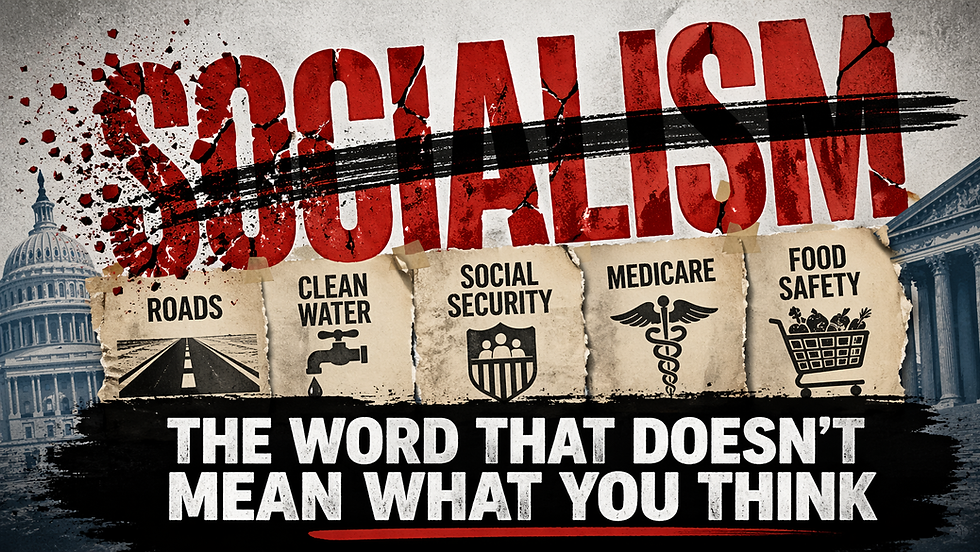
And yet, those systems don’t exist by accident. They’re built, maintained, and often regulated by the government. That doesn’t mean we live in a socialist country. It means we live in a system where public structures exist alongside private enterprise. The issue is that somewhere along the line, the word “socialism” got stretched so far that it started covering anything the government touches.
So let’s slow this down and define it clearly. Socialism, at its core, is about ownership and control of the major parts of the economy. In a socialist system, industries like energy, healthcare, or manufacturing are owned or controlled collectively, often by the state or by workers. The focus shifts away from private profit and toward public need. That’s the central idea.
That’s very different from what we have in the United States. The U.S. is a capitalist system. Most businesses are privately owned. Decisions are driven by profit. Companies compete, innovate, expand, or fail based on market forces. That’s the engine. That’s what drives the economy forward.
But that’s not the whole story. Because layered on top of that system are public programs and regulations. Things like Social Security, Medicare, public education, infrastructure, and safety standards. These don’t replace capitalism. They exist within it. They address gaps where the market doesn’t always produce outcomes that people find acceptable.
Here’s where the confusion kicks in. Programs like Social Security or Medicare are often labeled “socialism.” But they’re not examples of the government owning the economy. They’re examples of the government providing services or protections inside a capitalist framework. That’s not a semantic difference. It’s a structural one.
If the government runs a retirement program, that doesn’t mean it owns the companies you worked for. If it sets safety standards for food or medicine, that doesn’t mean it controls the industries producing them. It means there are rules. Boundaries. Guardrails.
And those guardrails exist for a reason. Businesses operate under a profit motive. That’s not inherently bad. It drives efficiency and innovation. But it also creates pressure to cut costs. And when safety becomes a cost, there’s always a risk that it gets reduced, delayed, or ignored.
Regulation didn’t appear out of nowhere. Agencies like the Food and Drug Administration or the Environmental Protection Agency exist because, historically, there were unsafe products, polluted environments, and harmful practices that needed to be addressed. These rules are not arbitrary. They’re responses to real problems.
There’s a legitimate conversation to be had about how much regulation is too much. Too many rules can slow growth, create inefficiencies, and make it harder for businesses to operate. That’s a fair point. But the idea that less regulation is always better ignores why those rules were created in the first place.
Every regulation is a kind of receipt. It represents a moment when something went wrong and a correction was made. Removing regulations without understanding that history doesn’t eliminate risk. It just shifts it somewhere else.
So when people say that liberals or progressives want to turn the United States into a socialist country, it’s worth asking what policies they’re actually referring to. Most proposals involve expanding access to healthcare, strengthening safety nets, or adjusting regulations. They don’t involve government ownership of most industries or eliminating private enterprise.
Take the Affordable Care Act as an example. It expanded access to healthcare, but it kept private insurance companies at the center of the system. You can debate whether it works well, but it’s not a move toward full socialism. It’s an adjustment within a capitalist framework.
Labeling everything “socialism” changes the conversation. It turns specific policy debates into broad ideological reactions. Instead of asking whether something works, people react to the label itself. And once that happens, the conversation shuts down before it even starts.
The reality is simpler than the rhetoric. We don’t live in a socialist system. We live in a capitalist system with public programs and regulations layered on top. The real debate isn’t about replacing one system with another. It’s about where the line should be drawn.
How much risk should individuals carry on their own? How much should be shared? How much regulation is necessary to protect people without stifling growth? Those are the questions that actually matter.
But we can’t answer those questions honestly if we’re using words that don’t mean what we think they mean. Because when the language gets distorted, the conversation follows. And when the conversation breaks down, so does our ability to make informed decisions about the system we’re all living in.
Sources
Social Security Administration — https://www.ssa.gov
Centers for Medicare & Medicaid Services — https://www.cms.gov
Food and Drug Administration — https://www.fda.gov
Environmental Protection Agency — https://www.epa.gov
Affordable Care Act overview (HealthCare.gov) — https://www.healthcare.gov/glossary/affordable-care-act/
Encyclopaedia Britannica — Socialism definition — https://www.britannica.com/topic/socialism
Encyclopaedia Britannica — Capitalism definition — https://www.britannica.com/topic/capitalism
If you want next, I can tighten this into:
a short email newsletter version, or
a TikTok caption thread version that breaks this into swipeable chunks.


Comments