BPF: The Legend of Obama’s Magic Cash Pallets
Mar 6
3 min read
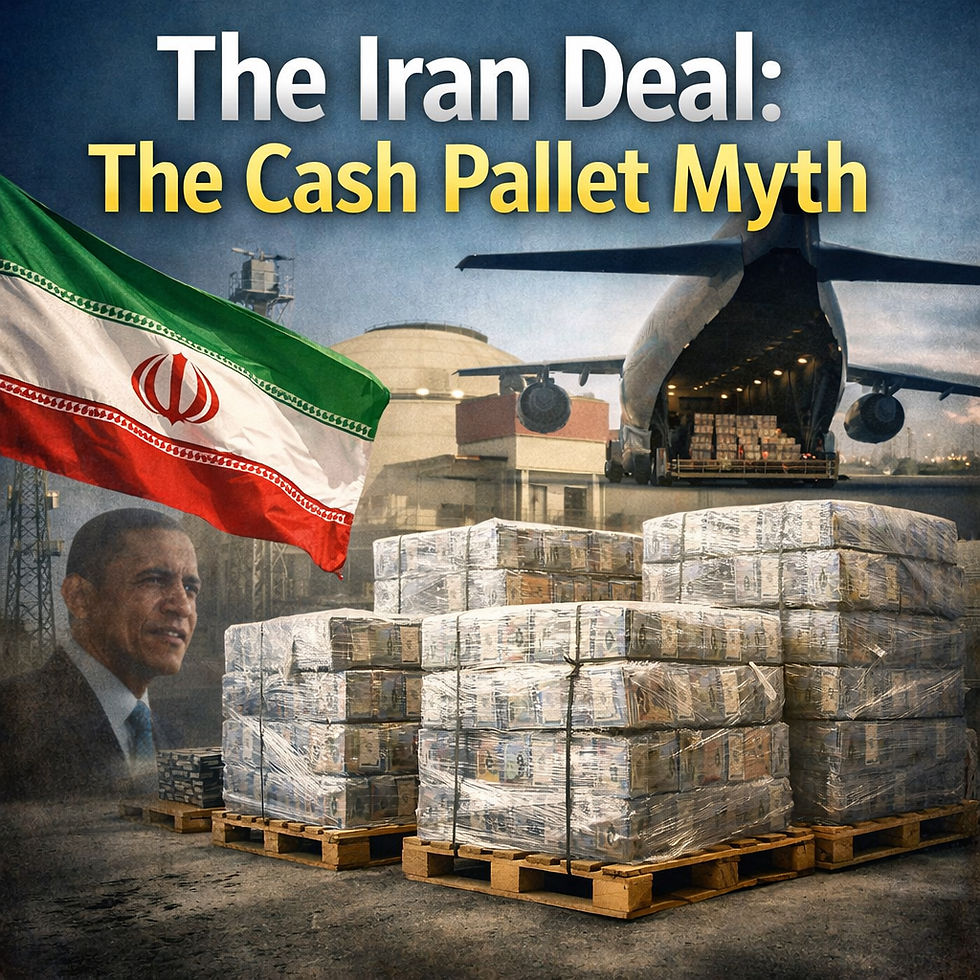
If you’ve spent any time in political discussions over the past several years, you’ve probably heard some version of this claim: that President Barack Obama “gave Iran pallets of American taxpayer money.”
Sometimes the number attached to that claim is $150 billion. Sometimes it’s $400 million. Often the story is told with dramatic language about planes loaded with cash and secret deals.
It’s a powerful narrative. The only problem is that it’s also deeply misleading.
The actual story behind the Iran nuclear deal — formally known as the Joint Comprehensive Plan of Action — is more complicated, and far less dramatic than the viral political version.
The agreement was negotiated in 2015 between Iran and six world powers: the United States, the United Kingdom, France, Germany, Russia, and China. The goal was straightforward: limit Iran’s ability to develop a nuclear weapon.
Under the agreement, Iran significantly reduced its nuclear capabilities. The country cut its stockpile of enriched uranium by about 98 percent, dismantled thousands of centrifuges used to enrich uranium, and redesigned a reactor that could have produced weapons-grade plutonium. In addition, inspectors from the International Atomic Energy Agency were granted extensive access to monitor Iran’s nuclear facilities.
In exchange for those restrictions, international economic sanctions on Iran were partially lifted.
That’s where the financial controversy begins.
For years, international sanctions had frozen tens of billions of dollars belonging to Iran in foreign banks. These were funds generated largely from oil sales and other international transactions. Because of sanctions, Iran could not access this money.
When the nuclear deal went into effect and certain sanctions were lifted, Iran regained access to some of those frozen assets.
In other words, the United States did not hand Iran a giant pile of American taxpayer money. Iran was allowed to access funds that already belonged to them but had been locked away under sanctions.
That distinction is important, but it often disappears in political arguments.
The second piece of the story — the part that produced the famous “pallets of cash” headline — involves a completely different issue.
In the 1970s, when Iran was still ruled by the Shah and was a close ally of the United States, Iran paid roughly $400 million for U.S. military equipment. Then came the Iranian Revolution in 1979. The new government was hostile to the United States, and the weapons were never delivered.
The United States kept the $400 million, and the dispute eventually went to an international arbitration tribunal in The Hague. For decades the case remained unresolved.
In 2016, the U.S. government agreed to settle the dispute rather than risk losing the case and paying even more in damages. The settlement totaled $1.7 billion — $400 million in principal and about $1.3 billion in accumulated interest.
Because Iran was still largely cut off from the global banking system, the initial $400 million payment was delivered in foreign currency, physically transported on pallets.
Those pallets of cash quickly became the centerpiece of a political talking point.
Critics argued that the payment amounted to a ransom because it occurred on the same day Iran released several detained Americans. The Obama administration maintained that the prisoner release and the financial settlement were negotiated separately, although officials acknowledged that the payment was not finalized until the Americans were safely departing Iran.
Reasonable people can debate whether the optics of that timing were good or bad. But the larger claim — that the United States simply gifted Iran enormous sums of taxpayer money — does not match the documented facts.
Most of the money commonly referenced in political debates involved Iran regaining access to its own previously frozen assets. The smaller payment that was delivered in cash was part of a legal settlement over a decades-old dispute.
Like many political controversies, the story became simplified and amplified as it spread. A complex international agreement turned into a viral talking point.
The reality of the Iran deal is still open to policy debate. Critics and supporters continue to argue about whether it was the best way to limit Iran’s nuclear program.
But those debates are more productive when they’re based on what actually happened, rather than on a story about “pallets of taxpayer cash” that leaves out most of the context.
Sources
Arms Control Association
The Joint Comprehensive Plan of Action (JCPOA) at a Glance
International Atomic Energy Agency (IAEA)
Monitoring and Verification in Iran under the JCPOA
Did Obama Give Iran $150 Billion?
U.S. Institute of Peace – Iran Primer
The U.S.–Iran Financial Settlement
U.S. Department of State (Archive)
Background on the Iran Nuclear Deal
CBS News
U.S. Sent $400 Million to Iran in Cash
The New York Times
U.S. Paid $400 Million to Iran as Americans Were Freed


Comments