Ep 80 - The Supreme Court’s June Knife Drawer
Jun 3
7 min read
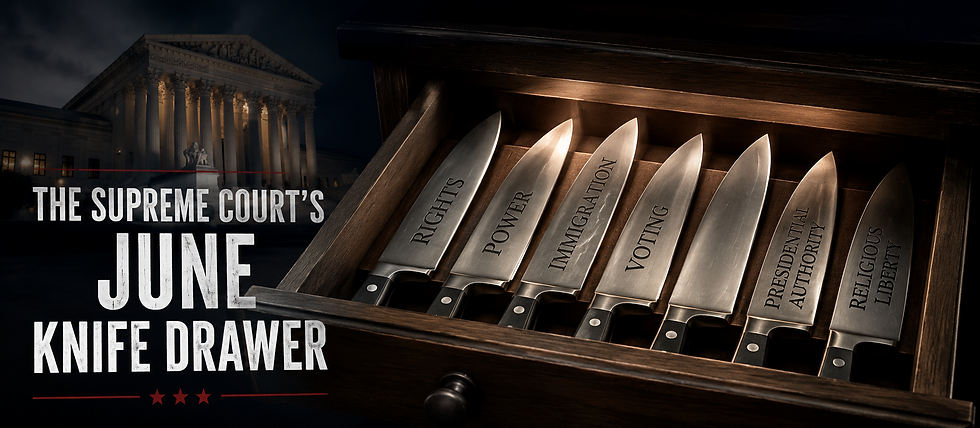
Every June, the Supreme Court opens the knife drawer. Most of the year, it sits there in the background of American life. The cases are argued, the briefs are filed, the justices deliberate behind closed doors, and most Americans go on living their lives without thinking much about what is sitting inside. Then June arrives, the drawer slides open, and suddenly everyone wants to know who is getting cut and with which knife.
That may sound dramatic, but it is not far from the truth. Supreme Court decisions do not just affect lawyers, scholars, and people who use the phrase “constitutional framework” in casual conversation. They affect workers, voters, women, immigrants, religious groups, students, LGBTQ Americans, corporations, government agencies, presidents, and sometimes all of us at once.
The Court is strange because it has no army, no police force, no election mandate, and no power to pass laws. It does not campaign. It does not hold town halls. It does not knock on doors asking for your vote. Yet nine unelected people in black robes can issue decisions that reshape American life for generations. That is an extraordinary amount of power resting on a very fragile foundation.
Most Americans only notice the Supreme Court when something explodes. That is especially true in June, when many of the biggest decisions of the term tend to arrive. The legal machinery has been running all year, but June is when the results become visible. Suddenly, abstract arguments become real consequences. Rights expand or contract. Presidential authority grows or shrinks. State power gets affirmed or limited. Rules people assumed were settled can become unsettled overnight.
That is why June feels less like a calendar month and more like a constitutional weather system. You may not have followed oral arguments. You may not know which justice wrote which concurrence. You may not have refreshed the Court’s website like a legal nerd waiting for concert tickets. But when the decision lands, you feel the impact anyway.
The uncomfortable truth is that the Supreme Court has become one of the central places where America’s unresolved arguments go to fight in formal clothing. Congress avoids hard decisions. Presidents push the limits of executive authority. States test boundaries. Advocacy groups sue. Lower courts split. And eventually, the Supreme Court is asked to answer questions the political branches either cannot or will not resolve.
That creates a democratic problem. Courts are supposed to be independent. We do not want judges checking polling numbers before deciding whether someone’s rights have been violated. But we also live in a democracy, and in a democracy, people are supposed to have some say in the rules that govern their lives. When the Court repeatedly decides enormous social questions, it is fair to ask how much power should rest in the hands of people no voter can remove.
History shows just how much power the Court has. Brown v. Board of Education helped dismantle state-sponsored school segregation. Miranda changed police procedure across the country. Roe reshaped abortion rights and American politics for nearly fifty years. Obergefell recognized same-sex marriage nationwide. Dobbs reversed Roe and changed the legal reality for millions almost overnight. Love those decisions or hate them, the pattern is undeniable: the Supreme Court does not merely interpret American life from a distance. It changes it.
That is why constitutional interpretation matters so much. It is not an academic game. It is not just professors arguing over commas while the rest of us try to remember our passwords. The way justices read the Constitution determines how old principles apply to new realities. And the country we live in now is not the country that existed when the Constitution was written.
The founders knew about newspapers, speeches, pamphlets, and letters. They did not know about the internet, social media, artificial intelligence, GPS tracking, DNA databases, cloud storage, or a government that can learn more from your phone than an eighteenth-century official could learn by searching your house. So when old constitutional language meets modern technology, every justice has to interpret. The argument is not whether interpretation happens. The argument is how much flexibility judges should have when doing it.
For decades, conservatives often presented themselves as defenders of fixed constitutional meaning. The Constitution meant what it meant when it was written or ratified, and judges were not supposed to update it based on changing social values. Progressives generally argued that constitutional principles remain, but their application must evolve as society changes. That was the basic fight: original meaning versus living application.
But now the lines are getting messier. Critics argue that some conservatives who once denounced reinterpretation now embrace aggressive new readings of presidential power, federal authority, administrative agencies, precedent, and even questions surrounding birthright citizenship. Conservatives would say they are restoring the Constitution’s original meaning. Critics would say they are reinterpreting the Constitution while pretending not to. That tension is not a footnote. It is central to why the Court feels so politically explosive.
Every justice claims to be following the Constitution. No one walks into the courtroom and announces, “Good morning, I plan to ignore the founding document today.” The fight is over what faithful interpretation actually means. Does the Constitution’s meaning stay locked to the understanding of the past, or do broad principles like liberty, equality, speech, and due process have to be applied to realities the framers could not have imagined?
Once Americans start believing constitutional interpretation is just politics wearing legal robes, the Court has a legitimacy problem. And legitimacy is the Court’s most important asset. It cannot force the country to trust it. It cannot pass a ruling requiring public confidence. It cannot declare itself above politics and expect everyone to nod politely while the building smolders behind it.
That trust has been damaged by confirmation wars, partisan maneuvering, and ethics controversies. The Garland blockade, the rapid confirmation of Amy Coney Barrett, the long political project to reshape the Court, and reporting about Clarence Thomas’s gifts and luxury travel have all fed the perception that the Court is not some neutral temple of law. To many Americans, it increasingly looks like a prize captured through politics.
The “who appointed them?” problem may be even more corrosive. More and more, Americans look at major rulings and immediately sort the justices by president: Trump appointee, Obama appointee, Bush appointee, Biden appointee. Instead of asking what the Constitution requires, people ask who put the justice there. That does not mean every case is partisan. Unanimous decisions still happen. Cross-ideological coalitions still happen. But perception matters, and the perception is getting uglier.
Dobbs poured gasoline on that perception. Conservatives spent decades working to overturn Roe. Republican presidents promised judges who would change the Court. Conservative legal organizations built pipelines. Trump appointed three justices. Then Roe fell. Conservatives called it a constitutional correction. Progressives looked at the machine, looked at the result, and said, “Come on. We watched this being built.”
That is the legitimacy crisis in plain language. The Court can survive disagreement. It always has. What it may not survive, at least not in the same form, is disbelief. If enough Americans stop believing the Court is acting from legal principle rather than partisan identity, every ruling becomes suspect. Every decision becomes another battle in the political war. Every knife looks sharper than the last.
And June is not over. There are still major questions sitting in the drawer involving executive power, immigration, religious liberty, voting rights, federal authority, and the reach of presidential action. The legal details vary, but the central question keeps repeating: who gets to decide, and how much power should they have?
That is what makes the Supreme Court so consequential and so dangerous at the same time. It can protect rights when other branches fail. It can restrain presidents who push too far. It can tell states they cannot violate the Constitution just because local majorities approve. But it can also erase protections, narrow rights, expand power, and reshape the country through decisions most Americans had no direct role in making.
The sharpest thing in the drawer may not be any single ruling. It may be the Court’s legitimacy itself. Because once people stop trusting the referee, every call becomes controversial. Once people stop believing the institution is bigger than the outcome, every decision looks like power dressed up as law. And once that happens, the drawer does not have to open very far for the whole country to flinch.
The drawer will close again soon. The headlines will fade. Politicians will fundraise. Cable news will shout. Social media will behave exactly as calmly and responsibly as we have all come to expect, which is to say, not at all. But next June, the drawer will open again. And we will all be back here, staring inside, wondering what changes next.
SOURCES
Supreme Court of the United States (official website and opinions) - https://www.supremecourt.gov/
Supreme Court opinion release schedule and term information (SCOTUSblog FAQ) - https://www.scotusblog.com/about/faqs-announcements-of-orders-and-opinions/
How and why Supreme Court decisions tend to cluster at the end of June (League of Women Voters) - https://www.lwv.org/blog/major-end-term-supreme-court-cases
Marbury v. Madison overview and judicial review (Oyez) - https://www.oyez.org/cases/1789-1850
Brown v. Board of Education summary and significance - https://www.quasilegalinstitute.org/resources/supreme-court-cases
Miranda v. Arizona (Oyez) - https://www.oyez.org/cases/1965/759
Obergefell v. Hodges (Oyez) - https://www.oyez.org/cases/2014/14-556
Dobbs v. Jackson Women’s Health Organization official Supreme Court opinion (PDF) - https://www.supremecourt.gov/opinions/21pdf/19-1392_6j37.pdf
The cases remaining before the Supreme Court at the end of a term (SCOTUSblog) - https://www.scotusblog.com/2025/06/remaining-supreme-court-cases/
What the Supreme Court still has left to decide this term (Vox) - https://www.vox.com/politics/487650/supreme-court-2026-term-what-is-left
How the Supreme Court is reshaping the 2026 midterm elections (Reuters) - https://www.reuters.com/legal/government/how-supreme-court-is-reshaping-us-midterm-elections-2026-05-31/
Supreme Court decision limiting sentence reductions under the First Step Act (Reuters) - https://www.reuters.com/legal/government/us-supreme-court-rejects-prison-sentence-reductions-under-reform-law-2026-05-28/
Supreme Court’s 2023 term and the rollback of Chevron deference (Reuters) - https://www.reuters.com/legal/legalindustry/supreme-courts-2023-term-blockbuster-businesses-2024-07-22/
Analysis of remaining election, executive power, immigration, gun rights, and LGBTQ cases before the Court (Vox) - https://www.vox.com/politics/487650/supreme-court-2026-term-what-is-left
Political divisions and tensions among Supreme Court justices in recent terms (Politico) - https://www.politico.com/news/2025/06/27/supreme-court-acrimony-00430590
For the blog post specifically, I'd also add one "Further Reading" section:
Oyez Project Supreme Court Case Archive - https://www.oyez.org/
SCOTUSblog - https://www.scotusblog.com/
These are two of the best nonpartisan resources available for readers who want to dig deeper into Supreme Court cases and Court procedure.



Comments