Ep 105 - Back Porch Files: Pandemic, Politics, and the Canceled Plan
Jul 31
9 min read
In the opening weeks of the COVID-19 pandemic, Donald Trump kept telling Americans that everything was under control. The number of cases would soon fall from fifteen to close to zero. The virus might disappear. It was comparable to the flu. The country could reopen quickly. The message was simple: do not worry too much, do not disrupt too much, and do not look too closely at the storm gathering just beyond the horizon.
Privately, Trump was saying something very different. In February 2020, he told journalist Bob Woodward that the virus spread through the air and was more dangerous than even a serious flu. Weeks later, he acknowledged that he was deliberately playing it down. That distinction matters. This was not simply a president making an innocent mistake because no one knew what was happening. He understood the danger in private and chose to communicate less urgency in public.
A president should not create panic. That part is true. Leaders should speak calmly during a crisis. They should prevent fear from becoming chaos. But calm leadership is not the same thing as misleading people. Preventing panic means telling the truth in a steady voice. It does not mean telling the public that a deadly airborne virus is about to disappear.
At the same time Trump was minimizing the threat, people inside his own White House were confronting a problem serious enough to require a coordinated national testing strategy. Jared Kushner, the president’s son-in-law and senior adviser, assembled an unconventional team that drew heavily from private-sector executives, consultants, volunteers, and people working around or alongside the traditional public-health agencies. The operation was improvised, its authority was often unclear, and its relationship with agencies like FEMA, HHS, and the CDC could be confusing. But the team understood one important thing: fifty states could not effectively fight the same national emergency as fifty separate competitors.
Testing was not simply a matter of producing more nasal swabs. A national testing system required chemical reagents, laboratory machines, trained personnel, transportation networks, protective equipment, data systems, and a reliable method for identifying shortages and moving resources where they were needed most. States were competing for many of the same materials, sometimes driving up prices and bidding against one another while the federal government stood nearby with greater purchasing power, broader information, and a logistics system no individual governor could match.
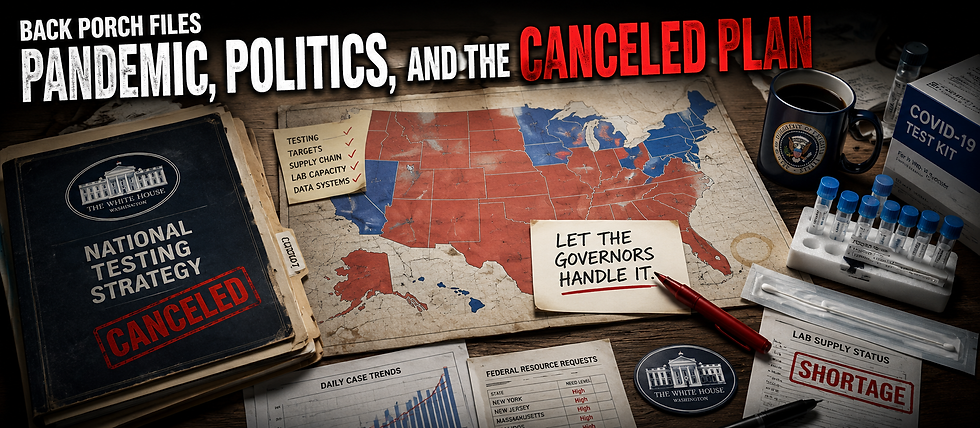
Kushner’s operation reportedly developed a proposal for stronger federal coordination. It included national testing targets, expanded laboratory capacity, improved supply distribution, better data collection, and a clearer picture of where the virus was spreading. It would not have been perfect. No testing plan could have prevented every infection or solved every pandemic failure. Supplies were scarce worldwide, technology was developing, and implementation would have been difficult. But perfection was never the relevant standard. The question was whether the United States would respond as one country or as fifty states trapped in the same emergency auction.
The national plan was not implemented. Instead, the Trump administration placed much of the responsibility on the states. Governors were expected to secure supplies, expand testing, manage shortages, and explain why their systems were failing. The federal government would assist, but it resisted becoming the central coordinator. That approach did more than decentralize the response. It decentralized the blame.
States do have major public-health responsibilities. Governors and local officials were essential. Different regions faced different conditions. But there were also functions that only the federal government could perform effectively. A governor cannot command a national supply chain. A governor cannot prevent all fifty states from competing for the same shipment. A governor cannot use the purchasing power of the entire United States. And a governor cannot build a complete national picture of a virus crossing state borders without asking permission.
The state-centered response created a politically useful arrangement. When supplies arrived, the White House could claim credit. When testing failed, Trump could blame the governors. Responsibility moved downward. Credit remained available at the top. And the president retained the freedom to decide which governors were cooperative, which were ungrateful, and which could be publicly attacked for failing to solve a problem that no state could solve alone.
Then came the most disturbing allegation. In July 2020, Vanity Fair reported that the national testing proposal had lost support and that a public-health expert involved with the effort had been told the outbreak was then concentrated largely in Democratic-led states. According to the reporting, political advisers saw an advantage in leaving responsibility with those governors. If the states failed, the administration could blame them. If a national plan succeeded, Democratic governors might look competent and receive some of the credit.
That allegation has limits, and those limits matter. There is no publicly released memorandum saying the plan was canceled because Democratic governors might benefit. There is no signed order explaining that partisan politics outweighed public health. The key account came through investigative reporting based partly on unnamed sources. The Trump White House denied that politics drove the decision. A later House majority-staff report cited the investigation, but it did not produce an independent smoking-gun document proving the motive.
That does not make the reporting meaningless. Anonymous sources are often necessary when journalists are revealing internal government discussions. People risk careers, access, and retaliation when they describe what happened behind closed doors. Anonymous sourcing should not be treated as automatically true, but neither should it be treated as automatically worthless. It has to be weighed against the broader conduct of the people involved.
And the broader conduct matters here. Trump repeatedly attacked Democratic governors. He expected public appreciation for federal assistance. He praised governors who complimented him and castigated those who criticized the federal response. He often treated cooperation as loyalty and criticism as ingratitude. The idea that political credit influenced his administration’s thinking does not arrive from another planet. It fits comfortably inside the way Trump governed.
If the reporting is accurate, the calculation was not necessarily, “How do we hurt Democratic voters?” It was more likely, “Why should we build a federal system that helps Democratic governors control the outbreak, look competent, and get the credit?” That is a different motive, but it is not a harmless one.
At the time, governors such as Andrew Cuomo were receiving enormous national attention. State leaders were being compared with Trump. Some appeared calmer, more prepared, and more serious than the president, who was still promising that the virus would vanish. A successful federal-state partnership might have strengthened those governors politically. A fragmented response gave Trump a cleaner arrangement. If a state succeeded, he could claim federal assistance had made it possible. If it failed, he could blame the governor.
The people living in those states were not political abstractions. Millions of Republicans lived there. Millions of independents lived there. Children, nurses, teachers, business owners, retirees, and people who had never voted in their lives lived there. A strategy designed around denying a governor political credit inevitably affects the ordinary people governed by that governor. Viruses do not check party registration before entering the lungs.
Trump’s obsession with testing numbers adds another layer to the story. He repeatedly complained that more testing produced more reported cases, as though the tests themselves were creating the infections. They were not. Testing revealed infections that already existed. Lower numbers could mean less disease, but they could also mean less detection. You can lower the number on a thermometer by refusing to look at it. The fever remains stubbornly unimpressed.
A large national testing program would have exposed the true scale of the outbreak. It would have contradicted the claim that the virus was drifting toward zero. It would have made the federal government more visibly responsible for what happened next. And it would have produced data that could not be easily folded into the story Trump wanted to tell about control, competence, and a country ready to reopen.
None of that proves every testing decision was motivated by politics. It does show that Trump repeatedly viewed testing through a political and public-relations lens. The same president who privately understood the danger publicly minimized it. The same administration that developed a national testing proposal shifted major responsibility to the states. And the same political operation that worried about case numbers had reason to worry about Democratic governors looking effective. That is not a written confession. It is a pattern.
Dr. Rick Bright’s whistleblower complaint adds context to that pattern. Bright, a senior federal vaccine and biomedical official, alleged that scientific warnings were resisted, political pressure influenced decisions about unproven treatments, and officials who challenged the preferred message faced retaliation. Bright did not prove why Kushner’s testing plan disappeared, and his case should not be used as direct evidence of the blue-state calculation. But his experience described an institutional culture in which science, loyalty, messaging, and political convenience were repeatedly colliding.
That brings us to the hardest question. Did the Trump administration want people in Democratic states to suffer? The available evidence does not establish that. There is no public order directing officials to harm Democratic voters. There is no document saying deaths were the desired outcome. Intent should not be invented simply because the consequences were horrific.
But intent is not the only measure of responsibility. Public officials are also judged by what they knew, what alternatives they had, what risks they accepted, who would bear those risks, and what benefits they expected to receive. A government cannot always escape moral accountability by saying that suffering was not the objective. Sometimes the more revealing question is whether suffering was foreseeable and politically acceptable.
Suppose the goal was not to hurt people. Suppose the goal was simply to avoid helping Democratic governors succeed. Suppose officials understood that a fragmented response would make testing slower, shortages worse, and control of the virus more difficult. Suppose they accepted those consequences because a stronger federal program might hand political credit to an opponent. Does the fact that suffering was not the stated goal make that calculation morally defensible?
Maybe the suffering was never the point. Maybe it was simply a cost someone was willing to accept. Whether that distinction makes it better, I’ll let you be the judge of that.
This is also a story about the weaponization of federalism. Federalism itself is not the problem. States should have power. Local officials often understand their communities better than Washington does. But federalism becomes a shell game when responsibility is pushed downward while resources, power, and credit remain concentrated at the top.
When Washington refuses to coordinate, denies states the tools they need, and then blames those states for predictable failures, that is not principled decentralization. It is political insulation. It allows the federal government to avoid ownership while preserving the ability to reward allies, punish critics, and treat public assistance as a favor from the president rather than an obligation of the government.
That danger extends far beyond COVID-19. The next crisis may be another pandemic. It may be a hurricane, a wildfire, a cyberattack, a terrorist attack, or an economic collapse. Whatever form it takes, the same democratic question will remain: does the president see one country, or a map divided into friendly states, hostile states, loyal governors, and political threats?
A president is allowed to dislike a governor. He is allowed to oppose that governor politically. He is allowed to campaign against that governor. But he does not get to treat the people of that state as collateral in a contest over credit and blame. Federal protection cannot become conditional on political loyalty without equal citizenship becoming conditional along with it.
Donald Trump said he wanted to play the virus down. In the end, he may have played down far more than the danger of COVID-19. He played down the urgency of preparation, the importance of testing, the responsibility of the federal government, and the moral cost of treating political rivals differently during a national emergency.
Government does not have to openly wish harm on its citizens to betray them. Sometimes it only has to understand the danger, possess the power to respond, and decide that the politics of helping matter more than the consequences of failing.
A pandemic does not care how a state voted. Neither should the government responsible for protecting it.
SOURCES
How Jared Kushner’s Secret Testing Plan “Went Poof Into Thin Air” — Vanity Fair investigation detailing the proposed national testing strategy, its abandonment, the blue-state political allegation, and the White House denial — https://www.vanityfair.com/news/2020/07/how-jared-kushners-secret-testing-plan-went-poof-into-thin-air (Vanity Fair)
The Trump Administration’s Pattern of Political Interference in the Nation’s Coronavirus Response — House Select Subcommittee majority-staff report citing the Kushner testing-plan investigation and documenting broader political interference — https://docs.house.gov/meetings/VC/VC00/20201002/111037/HHRG-116-VC00-20201002-SD020.pdf (House Documents)
Trump Administration COVID-19 Testing Blueprint — Official April 2020 framework assigning major testing responsibilities to the states — https://trumpwhitehouse.archives.gov/wp-content/uploads/2020/04/Testing-Blueprint.pdf (Trump White House Archives)
White House announcement of the state testing blueprint — Official description of federal and state responsibilities under the administration’s eventual testing policy — https://trumpwhitehouse.archives.gov/briefings-statements/president-donald-j-trump-ensuring-states-testing-capacity-needed-safely-open-america/ (Trump White House Archives)
February 26, 2020 coronavirus press conference — Official transcript containing Trump’s prediction that the fifteen confirmed cases would soon fall “down to close to zero” — https://trumpwhitehouse.archives.gov/briefings-statements/remarks-president-trump-vice-president-pence-members-coronavirus-task-force-press-conference/ (Trump White House Archives)
Trump and Bob Woodward COVID-19 conversations — Transcript of Trump privately describing the virus as airborne and deadly and later admitting that he deliberately played it down — https://www.rev.com/transcripts/donald-trump-bob-woodward-conversation-transcript-trump-playing-down-coronavirus (Rev)
PBS NewsHour report on the Woodward recordings — Audio-supported coverage contrasting Trump’s private knowledge with his public statements — https://www.pbs.org/newshour/show/audio-recordings-prove-trump-lied-about-coronavirus-danger (PBS)
March 24, 2020 coronavirus task-force briefing — Official transcript documenting Trump’s push to reopen the country and his discussion of Easter as a target — https://trumpwhitehouse.archives.gov/briefings-statements/remarks-president-trump-vice-president-pence-members-coronavirus-task-force-press-briefing-10/ (Trump White House Archives)
Trump’s comments that extensive testing made the United States “look bad” — PolitiFact review compiling his statements about reported case totals and slowing testing — https://www.politifact.com/factchecks/2020/jun/24/priorities-usa-action/trump-positive-coronavirus-tests-slowdown-look-bad/ (PolitiFact)
March 27, 2020 coronavirus briefing — Official transcript covering Trump’s insistence that governors should be appreciative of federal assistance — https://trumpwhitehouse.archives.gov/briefings-statements/remarks-president-trump-vice-president-pence-members-coronavirus-task-force-press-briefing-13/ (Trump White House Archives)
Rick Bright whistleblower complaint and supporting exhibits — Documents supporting Bright’s allegations of ignored warnings, political interference, pressure involving hydroxychloroquine, and retaliation — https://www.washingtonpost.com/context/exhibits-submitted-as-part-of-rick-bright-s-whistleblower-complaint/8b40193d-fe03-44f3-806e-34b7f680ebcc/ (The Washington Post)
Rick Bright whistleblower settlement — Reuters report on the federal settlement providing back pay and compensatory damages while distinguishing the retaliation claim from the underlying allegations — https://www.reuters.com/legal/government/us-settles-scientists-whistleblower-complaint-about-trump-covid-19-response-2021-08-09/ (Reuters)
“That’s Their Problem”: How Jared Kushner Let the Markets Decide America’s COVID-19 Fate — Additional Vanity Fair reporting on Kushner’s private-sector operation, federal reluctance to coordinate supplies, and competition among states — https://www.vanityfair.com/news/2020/09/jared-kushner-let-the-markets-decide-covid-19-fate (Vanity Fair)


Comments