Ep 133 - $45 and an American Flag: The Fine Print of School Choice
Oct 5
11 min read
Let’s say you woke up tomorrow and decided you wanted to open a school. Not work at one. Not volunteer at one. Not run for the school board. I mean open your own private school—a place where parents could theoretically send their children every morning and trust you with something as important as their education. You would probably assume there would be questions. What are your qualifications? Have you ever taught? Have you ever run a school? What curriculum are you going to use? How will you know if the kids are actually learning anything?
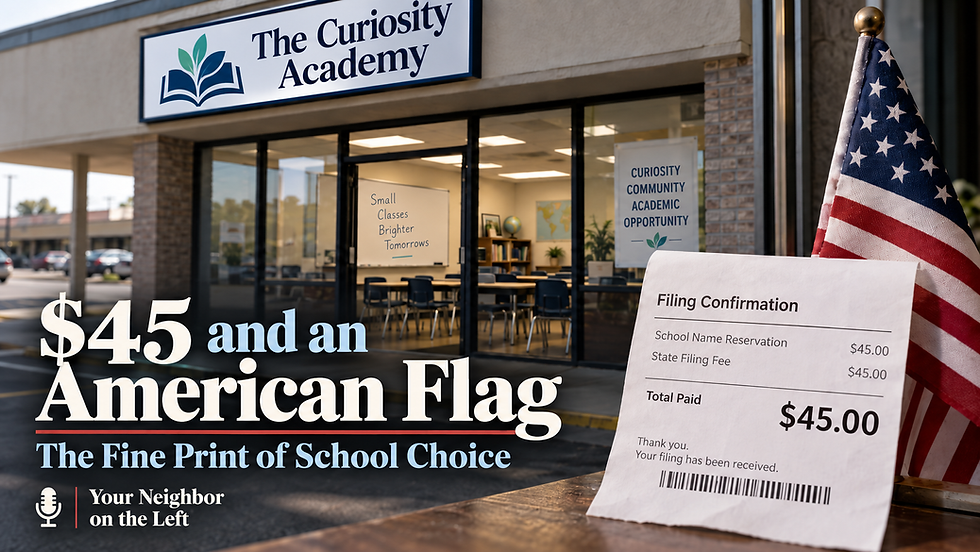
Reporters from ProPublica and the Arkansas Times recently decided to find out how difficult that process would be in Arkansas. They created a limited liability company, paid $45, and registered their school as a business. The registration was approved that same day. They did not have to prove they had teaching experience. They did not have to submit a curriculum to the state. They did not have to demonstrate any background in school administration. According to ProPublica, when they contacted the Arkansas Department of Education to ask what rules applied to opening a private school, a spokesperson told them, “We don’t have rules for opening a private school.”
There was, however, one concrete requirement. They needed an American flag. Arkansas law requires schools to display one. So these journalists—who had no teaching experience, no students, no curriculum, and no intention of actually running a school—went shopping for a flag. ProPublica reported that choosing the flag was the hardest part of the process. Forty-five dollars, an LLC, and an American flag. Congratulations. You own a private school.
That sounds like a funny government story. And it is. Until you realize Arkansas is also spending public money to help families purchase private education. That is where the joke stops being just a joke. Because once taxpayer dollars enter the equation, the question becomes larger than how easy it is to open a school. The question becomes: What exactly are we buying? And what might everyone else be paying for it?
School choice is one of those phrases that sounds almost automatically good. Choice. Who is against choice? Parents should have options. Families should not be trapped in schools that are failing their children. Some parents want religious instruction. Some want smaller classrooms. Some are looking for a safer environment, a different curriculum, or a setting better suited to a child with particular needs. Those are legitimate reasons to want alternatives.
But “school choice” is also a slogan. And slogans have a way of making complicated things sound simple. If you are going to support vouchers, Education Freedom Accounts, microschools, or other publicly funded private-school options, that is your prerogative. But you should understand what you are actually supporting. Not the brochure. Not the campaign ad. The policy.
Start with the phrase “private school.” What do you picture? If you are around my age, maybe something like Eastland Academy from The Facts of Life. Nice grounds. Established faculty. Tradition. Maybe you picture a Catholic school that has been in your community for generations. If you are younger, maybe something more like Las Encinas from Netflix’s Elite: polished, prestigious, selective, expensive-looking.
That image matters because “private school” can sound like a quality designation. It is not. It is a category. A private school can be a longstanding academy with an established administration and decades of history. It can also be a newly created microschool operating in a converted commercial space, a church, a farm, a home, or a strip mall. ProPublica’s broader reporting found exactly those kinds of schools. One was located between an antique store and an axe-throwing business.
That does not mean the school is bad. A beautiful campus can house a terrible school. A converted storefront can house a wonderful one. The building is not the issue. The point is that the words “private school” tell you surprisingly little about what is actually behind the sign on the door. Private is a category. It is not a quality rating.
The same is true of another word: “approved.” If the state tells a parent that a provider is approved to receive thousands of dollars in public education funding, what does that parent reasonably assume? Maybe that someone inspected the place. Maybe that someone reviewed the curriculum. Maybe that the operator had to demonstrate educational experience or financial stability. Maybe that teachers had to meet specific qualifications. Maybe that someone is tracking whether the students are actually learning.
Sometimes some of those things are true. Sometimes they are not. And the requirements can change dramatically depending on the state and even on the category of provider within the same state. That is why the fine print matters. If parents are expected to provide market accountability by choosing good schools and leaving bad ones, then they need to know what the state has already checked—and what it has not.
Arkansas is a good example of why those distinctions matter. The journalists’ $45 experiment showed how little was required merely to establish a private school. But opening a private school is not the same as automatically qualifying to receive Education Freedom Account money. Arkansas has additional requirements for participating schools and providers. That distinction matters, and pretending otherwise would make the criticism weaker, not stronger.
But Arkansas also recognizes multiple kinds of providers within its Education Freedom Account system, including private schools, microschools, learning pods, and other full-time student-facing providers. For the 2026–27 school year, the standard Education Freedom Account is $7,208 per student, with a higher amount available for certain qualifying students. So yes, microschools can participate in a system funded with public dollars.
ProPublica pushed its experiment further and tested the initial application process for becoming an Education Freedom Account-eligible microschool or provider. According to the reporters, the application took about ten minutes. They submitted basic information, a tuition and fee schedule, and a refund policy. At that stage, they were not required to demonstrate accreditation or financial solvency. Additional requirements would have applied if they had actually moved forward, but the initial process was far lighter than many people might imagine when they hear the phrase “approved educational provider.”
West Virginia offers another example of how much the rules can depend on what kind of school you say you are opening. There, the journalists initially tried the conventional private-school route and encountered a legitimate fire-safety requirement. They did not want to waste public resources having inspectors evaluate a newsroom for a school that would never exist, so it looked like the experiment might end there. Instead, an education official suggested they consider the microschool route.
Under that route, the state played a much smaller role. West Virginia’s Department of Education told ProPublica that it “does not approve or deny the operation of microschools for any reason, including the qualifications of the owner/operator.” And according to ProPublica, West Virginia microschools can have unlimited enrollment. Apparently the “micro” part is more of a vibe.
North Carolina, however, shows why it is important not to talk about vouchers as though every state is doing the same thing. The ProPublica experiment did not work the same way there. Reporters attempted to establish a private school at a brewery and ran into fire and sanitation inspection requirements. They stopped because they did not want to waste inspectors’ time on a school that would never actually open. North Carolina also imposes additional requirements before schools can participate in its voucher program.
That variation is the point. There is no single national voucher system. Different states make different choices about safety requirements, operator qualifications, inspections, testing, background checks, and public funding. Two politicians can both say they support “school choice” while advocating systems that function very differently. The slogan tells you almost nothing about the architecture underneath it.
Supporters of vouchers often respond with what may be the strongest argument on their side: parents provide the accountability. If a school is bad, parents leave. Bad providers lose students. Good providers attract them. Competition rewards success and punishes failure. There is something intuitive about that argument, and parents absolutely should have a major role in their children’s education.
But parents are not regulatory agencies. I know a lot of teachers, in both public and Catholic schools, and one thing I hear repeatedly is that parental involvement exists on a huge spectrum. Some parents are deeply engaged, cooperative, responsive, and supportive. Some are helicopter parents who challenge every consequence and demand exceptions for their child. Others are difficult to reach, miss meetings, or show little visible involvement in the educational process.
That is not an indictment of parents. People are busy. Some are working multiple jobs. Some are dealing with family problems, transportation issues, health issues, or financial stress. Some had bad experiences with schools themselves. Parents are human beings with different levels of time, knowledge, resources, and engagement. That is exactly why it is risky to place too much of the accountability burden on them.
Can an ordinary parent independently verify whether every employee’s background check was performed properly? Can they audit financial records? Can they determine whether public funds are being spent appropriately? Can they evaluate whether academic performance is comparable to other schools? Can they determine whether the school is financially stable enough to still exist two years from now? Those are not ordinary parenting tasks. Those are institutional oversight tasks.
We understand this principle in other areas of life. We choose where we eat, but the government still inspects restaurant kitchens. We do not say, “If enough people get salmonella, the market will eventually sort it out.” Consumer choice and baseline regulation are not mutually exclusive. Parents should be part of the accountability system. They should not have to be the entire accountability system.
There is another problem with relying on the market to correct poor schools: time. If a parent realizes after two years that a school is not providing adequate instruction, they can transfer their child. The school may lose revenue. The market may eventually punish the provider. But the child already spent those two years there. Education is not a toaster. A bad purchase can be replaced. Lost instructional time cannot simply be returned for a refund.
And so far, all of these questions concern what the family is buying. But there is another side to the transaction. What happens to the public system surrounding that choice? Voucher opponents often say vouchers take money from public schools. Voucher supporters respond that the money follows the child. Both statements are too simple.
Public-school funding works differently from state to state, but enrollment matters almost everywhere. When students leave, districts may eventually receive less funding. The problem is that costs do not disappear one student at a time. If six students leave a school, the district cannot sell six seats off a school bus. It cannot turn off two percent of the furnace. It cannot remove three percent of the roof. It still needs buildings, transportation, cafeterias, counselors, custodians, teachers, and special-education infrastructure.
That does not mean public-school costs never adjust. They do. If enough students leave over time, districts can consolidate classes, reduce staff, change bus routes, or close buildings. But the important point is that revenue can fall faster than costs can adjust. Students can leave one at a time. School expenses usually cannot.
Then there is the phrase “the money follows the child.” It sounds tidy, and sometimes it makes sense. If a student leaves a public school and moves to a private school using a voucher, supporters can reasonably argue that some education funding has followed that student. But what if the student was already attending private school? What if the family was already paying tuition and the state now begins paying part of that bill? That money did not follow the child out of the public system. The child was never there. That is new public spending.
Arkansas’s own fiscal analysis recognizes this distinction by separating students who otherwise would have attended public school from those whose education would not otherwise have been a public-school expense. That matters because the fiscal impact of vouchers depends heavily on who receives them. Sometimes the money follows the child. Sometimes the state simply starts paying a bill the family was already paying.
That does not automatically make the spending wrong. Maybe you believe taxpayers should help those families too. That is a legitimate policy argument. But it should be described honestly. The accounting is more complicated than the slogan.
And that brings us to the larger principle underneath all of this: public money creates some degree of public obligation. That does not mean private schools should be forced to operate exactly like public schools. In fact, one of the arguments for school choice is that private alternatives should be free from some of the bureaucracy imposed on traditional systems. That argument deserves to be taken seriously.
But where is the reasonable minimum? If taxpayers are funding a school, are they entitled to know whether children are safe? Whether employees have been properly screened? Whether the money is being used for legitimate educational purposes? Whether meaningful instruction is occurring? Whether academic progress is being measured? Whether fraud can be detected? Those do not strike me as radical demands. They strike me as baseline questions.
So if you listen to all of this and still support vouchers, fine. Maybe you believe parental freedom outweighs the risks. Maybe you think competition will improve schools. Maybe your local public school has failed families in ways that cannot be ignored. Maybe you believe more options are worth the tradeoffs. Those are arguments you are entitled to make.
But make that decision knowing what the policy actually does. Know what legally counts as a private school. Know what a microschool can be. Know what “approved” really guarantees. Know what parents are expected to evaluate themselves. Know what happens when a provider fails. Know where the public money comes from. Know what happens to public districts when revenue declines faster than costs can adjust.
If you still support vouchers after knowing all of that, then support them. But support the actual policy—not the commercial for it.
Which brings me back to that American flag in Arkansas. The reporters did not have to demonstrate teaching experience. They did not have to demonstrate school-administration experience. They did not have to submit a curriculum to the state just to establish the private school. But they did need a flag. At the beginning of this story, that detail is funny. By the end, it feels almost symbolic.
That flag represents a country where citizens get to make choices about public policy. We get to decide how we educate children. We get to decide whether taxpayers should help families purchase private education. We get to decide how much freedom should come with that money and how much oversight should follow it. Reasonable people can disagree about those choices.
So choose. But understand the choice. Understand what you are buying. Understand who checked it. Understand who did not. Understand what happens if it fails. Understand where the money comes from. And understand what the larger community may be giving up to pay for it.
“School choice” is two words. Public education policy is considerably more complicated. Before we start moving billions of public dollars around in the name of choice, maybe the least we can do is read the fine print.
SOURCES
ProPublica investigation: “We’re Reporters, Not Teachers. We Were Able to Start Private Schools Anyway.” - https://www.propublica.org/article/propublica-private-schools-arkansas-west-virginia-north-carolina
ProPublica investigation on the growth of voucher-funded private schools and microschools - https://www.propublica.org/article/private-schools-vouchers-growth-florida-arizona-west-virginia
Arkansas Department of Education — Education Freedom Accounts information for families - https://dese.ade.arkansas.gov/offices/office-of-school-choice-and-parent-empowerment/education-freedom-accounts/information-for-families
Arkansas Department of Education — Education Freedom Accounts information for service providers, including microschools and learning pods - https://dese.ade.arkansas.gov/Offices/office-of-school-choice-and-parent-empowerment/education-freedom-accounts/information-for-service-providers
Arkansas Department of Education — requirements for participating private schools and microschools - https://dese.ade.arkansas.gov/Offices/office-of-school-choice-and-parent-empowerment/education-freedom-accounts/information-for-private-and-micro-schools
Arkansas Department of Education — 2024–25 Education Freedom Accounts annual report and fiscal analysis - https://dese.ade.arkansas.gov/Files/2024-25_Arkansas_Education_Freedom_Accounts_Program_Annual_Report_100125_OSCPE.pdf
North Carolina Department of Administration — private school requirements, inspections, and compliance rules - https://www.doa.nc.gov/divisions/non-public-education/private-schools/requirements
Brookings Institution — analysis of school-choice policy design, accountability, information, and access - https://www.brookings.edu/articles/with-vouchers-and-other-school-choice-policies-read-the-fine-print/
National Bureau of Economic Research — research on competitive effects of school voucher programs - https://www.nber.org/papers/w21523
Netflix Tudum — background on Elite and Las Encinas as an exclusive private school - https://www.netflix.com/tudum/elite


Comments