BPF - Government by Meme: How Viral Posts Are Reshaping Political Reality
Mar 13
4 min read
If you spend any amount of time scrolling through social media, you’ve probably seen it happen.
A dramatic political claim appears in your feed. It might be a screenshot, a short video clip, or a meme with bold text and a shocking headline. Within hours, it’s everywhere. Friends are sharing it. Comment sections are exploding. People are arguing about it like it’s already a confirmed fact.
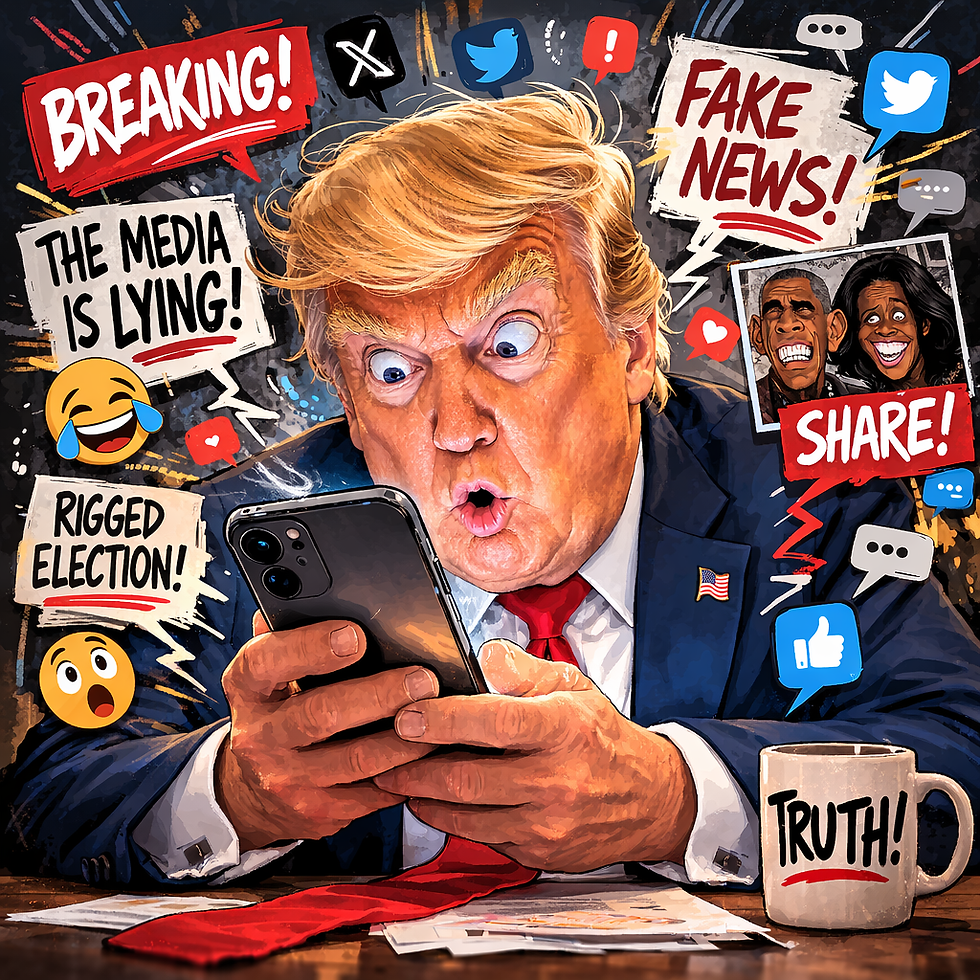
But sometimes, when you dig deeper, the story turns out to be exaggerated, misunderstood—or completely false.
Welcome to the age of government by meme.
Memes themselves are nothing new. They’ve been part of internet culture for decades. A clever meme can capture a political moment in a way that’s funny, sharp, and instantly recognizable. But in recent years memes have evolved from simple jokes into powerful political messaging tools.
And they spread faster than almost any other form of information.
The Viral Rumor Pipeline
Most viral political rumors follow a familiar path.
First, a claim appears on social media platforms like X, TikTok, or Threads. Sometimes it’s a cropped video clip without context. Sometimes it’s a screenshot of a headline. Sometimes it’s simply text over a dramatic image.
The post starts getting shared. Then an influencer reposts it. Someone turns it into a meme. Soon it spreads across multiple platforms.
By the time journalists begin investigating whether the claim is accurate, millions of people may have already seen it.
And here’s the catch: the correction rarely travels as far as the original claim. A viral post built around outrage or shock is far more likely to spread than a careful explanation that says, “Well, actually, it’s more complicated than that.”
The Hidden Role of Bot Accounts
Another factor that amplifies viral misinformation is the presence of automated “bot” accounts.
Researchers studying online disinformation have identified large networks of bots operating on social media. These automated accounts can repost content, repeat hashtags, and flood comment sections in ways that make certain ideas appear far more popular than they actually are.
In some cases, a handful of viral posts can be artificially boosted by thousands of automated accounts, creating the illusion of widespread public support or outrage.
Once a post gains that early momentum, social media algorithms often do the rest by promoting the content to even larger audiences.
When Politicians Share the Memes
Political figures themselves have increasingly participated in the meme ecosystem.
One prominent example is Donald Trump, who has repeatedly shared memes and viral posts with his followers. Over the years, Trump has amplified everything from exaggerated claims to crude internet memes.
Most recently, Trump drew criticism for reposting a racist meme that depicted Barack Obama and Michelle Obama as apes. The post circulated widely online before eventually being removed, but not before reaching millions of users.
When major political figures amplify viral content, it can rapidly move from the fringes of the internet into the mainstream political conversation.
Why Memes Spread So Easily
Memes are effective because they simplify complicated issues. Government policy, economics, and international affairs are inherently complex topics. Memes compress those topics into a format that can be understood in seconds.
They also tap into emotion. Social media algorithms prioritize posts that generate reactions—especially outrage. Content that makes people angry, shocked, or amused is more likely to be shared, which pushes it further into users’ feeds.
The result is an information ecosystem where emotional content spreads faster than careful analysis.
The Risk for Democracy
At first glance, meme-driven politics might seem harmless—even amusing. But there’s a deeper concern.
Democracy depends on citizens being able to debate ideas based on a shared understanding of reality. When different groups are relying on entirely different sets of viral claims, that shared understanding begins to break down.
People stop debating policy solutions and instead argue over basic facts.
And that makes productive political conversation much harder.
Navigating the Meme Era
Memes aren’t going away. They’re a permanent part of internet culture and modern political communication.
But navigating the meme era requires a little more skepticism.
Before sharing a dramatic claim online, it’s worth pausing to check whether the story is supported by credible reporting. Looking for multiple sources and understanding the full context of a story can go a long way toward slowing the spread of misinformation.
Because sometimes the most important step in today’s political environment is the simplest one: Checking before sharing.
Sources
Pew Research Center – Social Media and News Consumptionhttps://www.pewresearch.org/journalism/fact-sheet/social-media-and-news-fact-sheet/
Pew Research Center – Bots and Political Information on Social Mediahttps://www.pewresearch.org/internet/2018/04/09/bots-in-the-twittersphere/
MIT Study on the Spread of False News Online (Science Journal)https://www.science.org/doi/10.1126/science.aap9559
Brennan Center for Justice – Disinformation and Social Mediahttps://www.brennancenter.org/our-work/research-reports/disinformation-and-social-media
Brookings Institution – How Misinformation Spreads Onlinehttps://www.brookings.edu/articles/how-misinformation-spreads-online/
Reuters Institute Digital News Report – Social Media and News Trusthttps://www.digitalnewsreport.org
Associated Press – Coverage of Viral Political Misinformationhttps://apnews.com/hub/misinformation
Reuters Fact Check – Political Misinformation Databasehttps://www.reuters.com/fact-check/
Snopes – Political Fact Checking Archivehttps://www.snopes.com/fact-check/
PolitiFact – Political Fact Checking Databasehttps://www.politifact.com/


Comments